🤝 Data Governance Is a Team Sport
Why silos kill governance — and collaboration saves it.
📘 What Sparked This Thought
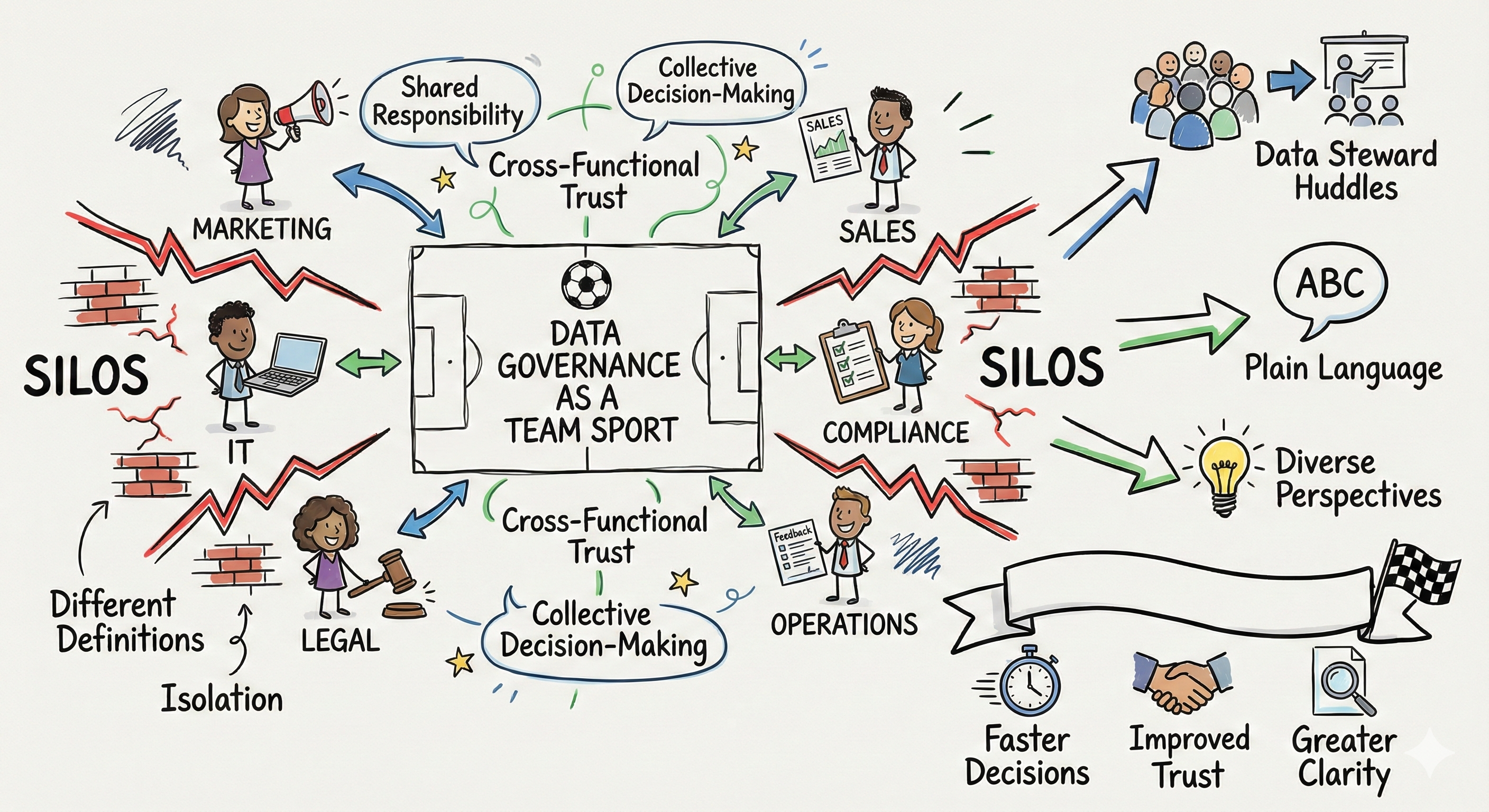
Ever been in a meeting where Marketing, IT, and Legal all have different “truths” about the same dataset or same report?
I’ve witnessed this scenario play out countless times — and it’s rarely because people don’t care. It’s because governance is being treated as a gatekeeper, not a team sport.
In one particularly memorable session, we had three departments arguing over a simple metric: “Active Customers.”
- Marketing counted anyone who opened an email in the last 90 days.
- Sales counted anyone with an open opportunity.
- Finance counted anyone who made a purchase in the last quarter.
Same term. Three definitions. Zero alignment.
The problem wasn’t the data itself. The problem was that governance lived in isolation — owned by a single team, enforced through policy documents nobody read, and disconnected from the people who actually used the data.
💡 My Understanding
Data Governance works best when it’s a shared responsibility — not a single department’s burden.
Here’s the truth that took me years to learn: Governance isn’t “IT’s problem” or “Legal’s checklist.” It’s a company-wide agreement that:
- ✅ Data is a strategic asset
- ✅ Everyone is a steward, not just consumers
- ✅ Decisions on data require multiple perspectives
When governance is siloed, it feels like bureaucratic red tape. Nobody knows what’s happening, and everyone gets frustrated.
When it’s collaborative, it becomes an enabler. Teams move faster because they trust the foundation. Decisions are made with confidence because everyone agrees on the definitions.
The Shift: From Gatekeeper to Coach
Traditional governance models position the “Data Governance Team” as gatekeepers — the people who say “no” to protect data quality.
The collaborative model positions them as coaches — helping teams understand the rules of the game and enabling them to make better plays.
Gatekeepers block.
Coaches enable.
That’s the difference.
🔍 Real-World Example: The “Data Steward Huddle”
I worked with a financial services company that was drowning in governance overhead. They had a 200-page governance framework that nobody read, quarterly compliance reports that gathered dust, and a Data Governance Committee that met once a quarter for 3-hour sessions filled with spreadsheets and yawns.
They scrapped it all.
Instead, they created something radical: Monthly cross-functional “Data Steward Huddles.”
Here’s how it worked:
- Marketing brought customer engagement data and campaign performance metrics.
- IT brought infrastructure updates and lineage reports showing data flows.
- Risk & Compliance brought regulatory updates and audit findings.
- Operations brought feedback from the ground — what worked, what broke, what was confusing.
The meetings were 60 minutes max. No PowerPoints. Just conversations.
The Results
- Issue Resolution Time dropped from 3 weeks to 3 days because the right people were in the room.
- Data Definition Conflicts were resolved immediately instead of escalating through email chains.
- Trust improved because teams understood each other’s constraints and priorities.
Instead of long governance documents nobody read, decisions were made in the room, with everyone understanding the “why.”
That’s governance as a team sport.
🔄 Practical Moves Toward Team-Based Governance
If you’re trying to shift from siloed to collaborative governance, here are the tactical moves that work:
1. Build a Data Governance Council with Diverse Roles
Don’t just invite IT and Legal. Include:
- Business Leaders who use the data to make decisions
- Analysts who work with the data daily
- Engineers who build the pipelines
- Compliance to ensure regulatory alignment
Why it works: Diverse perspectives catch blind spots.
2. Rotate Meeting Facilitators
Don’t let governance become “IT’s meeting.”
Let Marketing run one month. Sales the next. Operations after that.
Why it works: Ownership rotates. Engagement follows.
3. Use Plain Language Over Technical Jargon
Replace “Data Lineage Metadata Enrichment” with “Where does this number come from?”
Why it works: Non-technical stakeholders participate instead of tuning out.
4. Share Quick Wins
Celebrate when governance prevents a disaster or enables a fast decision.
Make governance visible, not invisible.
Why it works: People support what they see working.
5. Create Feedback Loops
After every governance decision, ask: “Did this help or hurt velocity?”
Adjust accordingly.
Why it works: Governance evolves instead of ossifying.
✅ Key Takeaways
- Governance isn’t a one-person job — it’s a network of stakeholders with shared accountability.
- Cross-functional trust is the real governance currency — more valuable than any policy document.
- Meetings should produce actions, not just agreements — if nothing changes after your governance meeting, it was theater.
- Start small and iterate — don’t wait for the “perfect” governance framework. Ship v1, learn, and improve.
🤔 Questions I’m Still Thinking About
- How do you make governance meetings the meeting people want to attend instead of the one they try to skip?
- Can governance KPIs be tied to business outcomes (like time-to-decision) instead of just policy completion rates?
- What does governance look like in a fully decentralized data mesh architecture where domains own their data?
- How do we balance speed (move fast, ship often) with safety (don’t break compliance)?
💬 Final Thoughts
The best governance frameworks aren’t written in policy binders or locked away in SharePoint.
They’re built in conversations, decisions, and trust.
When you treat governance as a team sport, something magical happens: People stop seeing it as a burden and start seeing it as a competitive advantage.
Because the team with the best governance doesn’t just have better data.
They have faster decisions, clearer strategy, and more confidence.
And in a world drowning in data, confidence is currency.